How to Build a Content Calendar for Bootstrapped Brands (Without Losing Your Mind)
No agency. No big budget. No problem. The step-by-step system for turning scattered effort into compounding momentum — even when you're a team of one.
⌗ Strategy receipt — why this post exists
Trigger
"I know I should be posting consistently, but I have no system" — the most common growth blocker for solo founders
Theme · Audience
Content strategy · Bootstrapped founders, early-stage teams of 1–3
The move
Give them a concrete system with a real-world example — no fluff, no agency budget required
Channels
Blog → LinkedIn tutorial → email newsletter
If you're running a bootstrapped brand, you already know the deal: you're the founder, the marketer, the customer service rep, and sometimes the shipping department. Building a content calendar feels like a luxury — something the big brands with full content teams do.
It's not. A solid content calendar for bootstrapped brands is actually your unfair advantage, because it turns scattered effort into compounding momentum.
Before you start, you'll need:
- A ThinkContent account — the free tier works for this
- A clear sense of your one primary audience (we'll sharpen this together)
- 60–90 minutes for your first setup session
- Your top 2–3 channels identified — don't try to be everywhere on day one
Step 1: Anchor Everything to Your Brand Messaging
A content calendar without a messaging foundation is just a list of things to post. Before you touch dates or topics, open ThinkContent and complete the Brand Voice module. This is where you define what your brand stands for, who it's talking to, and what it should sound like.
Answer the prompts honestly. If you're a solo founder selling handmade leather goods, say that. If you started your skincare line because conventional products made your eczema worse, say that too. ThinkContent's AI uses these inputs to keep every piece of content you plan aligned with your actual story — not a generic version of it.
Once your Brand Voice is set, the platform locks it in as a reference layer. Every content suggestion, every caption, every email draft will pull from it. This is what keeps a bootstrapped team of one or two people sounding consistent across Instagram, email, and LinkedIn without having to manually QA everything.
A content calendar without a messaging foundation is just a list of things to post.
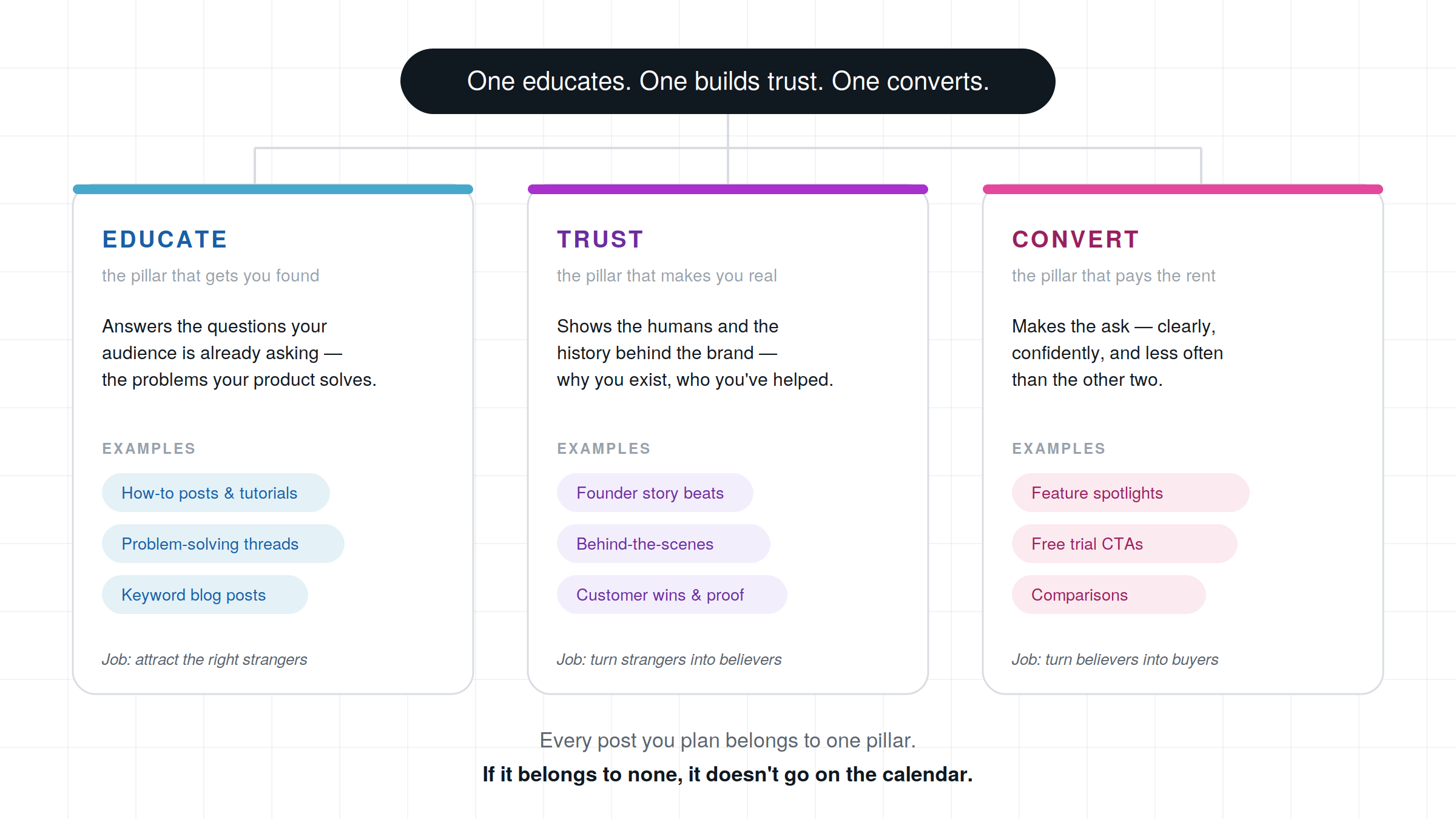
Step 2: Define Your Content Pillars (Keep It to Three)
In ThinkContent's Strategy section, you'll build your content pillars — the three to four core themes your content will rotate around. For a bootstrapped brand, less is more here.
A useful framework: one pillar educates, one builds trust, one drives action.
For example, if you run a small B2B software tool:
- Educate: How-to content around the problems your tool solves
- Trust: Behind-the-scenes, founder story, customer wins
- Convert: Product features, free trial CTAs, comparisons
ThinkContent will prompt you to connect each pillar to a specific audience pain point and channel. Take that step seriously — it's what prevents you from creating content that feels random or disconnected.
Wilmer's note: The brands I watch grow fastest aren't posting the most — they're posting the most *intentionally*. One message, three pillars, a 30-day window. That's it. The secret isn't volume. It's showing up with the same clarity every single time until your audience starts showing up for you.
Step 3: Map Your Calendar in the Planner
Now open the Content Planner. This is your actual calendar view — weekly or monthly, your choice.
Start with a 30-day window. Bootstrapped brands often make the mistake of planning three months out before they've found their rhythm. One month gives you enough structure to be consistent without locking you into a plan that doesn't fit how your audience actually responds.
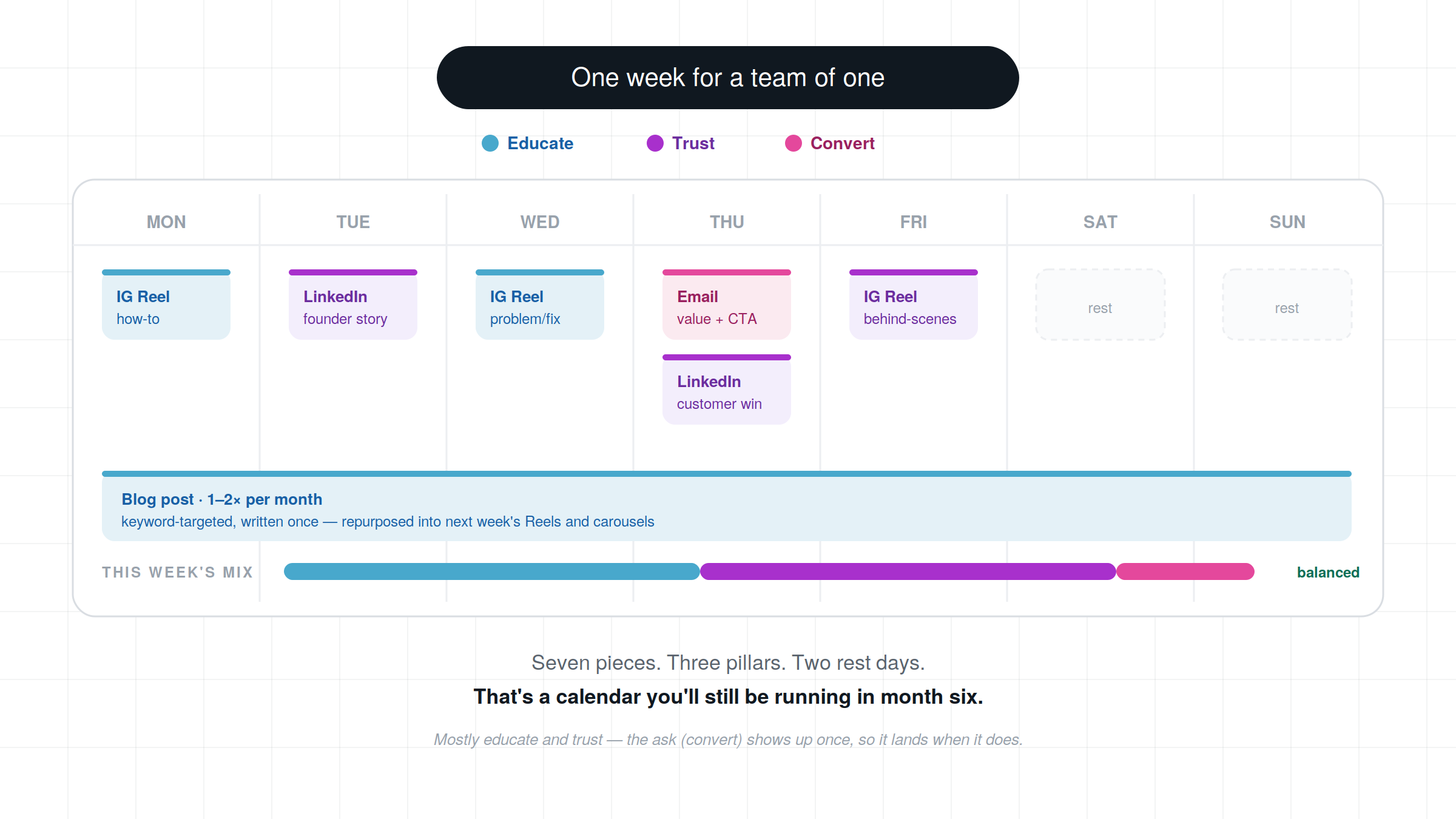
Here's a realistic publishing cadence for a one-person brand:
- Instagram/TikTok: 3× per week (Reels or short video)
- LinkedIn: 2× per week (text posts or carousels)
- Email: 1× per week (short, value-first)
- Search/Blog: 1–2× per month (longer, keyword-targeted)
In ThinkContent, drag content blocks into your calendar slots and assign each one a pillar, a format, and a channel. The platform flags gaps and imbalances — if you've loaded up on conversion content and skipped education for two weeks, it'll surface that.
Use the AI Content Brief feature to generate a working outline for each piece directly from the calendar block. You're not outsourcing your voice — you're eliminating the blank page.
Step 4: Build a Simple Repurposing Loop
One piece of content should never live in just one place. In the Planner, use the Repurpose tag to link related content across formats. Your blog post becomes a LinkedIn carousel. Your carousel becomes three Instagram captions. One of those captions becomes a TikTok hook.
ThinkContent tracks these connections so you're not starting from scratch every time you sit down to create. For a bootstrapped brand, this multiplier effect is everything.
Troubleshooting: When the Calendar Slips
"I set up the calendar but I'm already falling behind."
Scale back before you give up. Cut your cadence in half and protect it. Two consistent posts per week beats seven inconsistent ones every time. Go back into ThinkContent's Planner and reduce your scheduled slots — consistency compounds, volume doesn't.
"The content feels generic even with the AI."
Return to your Brand Voice module and add more specificity: real customer language, a personal origin story beat, or a strong opinion your brand holds. The AI reflects what you give it. Richer inputs produce sharper outputs.
"I don't know what to write about."
Use ThinkContent's Keyword and Topic Discovery tool inside the Strategy section. Filter by your audience type and content phase. You'll surface what your specific buyers are actually searching for — not what you assume they want.
---
A content calendar for your bootstrapped brand isn't about doing more. It's about doing the right things consistently enough that they start working for you. Start with 30 days. Build the habit. Then scale.